
Technology has become part of almost every business, whether it is a small local company, a hospital, a financial institution, or an international organization. Companies depend on digital systems to manage payments, store documents, communicate with customers, and deliver services, but the security risks connected to these systems are not always fully understood by the people who depend on them.
Cybersecurity is often considered a technical responsibility that belongs entirely to IT departments or external specialists. While these professionals have an important role, business owners, managers, employees, and service providers also make decisions that influence how well an organization protects its information and operations.
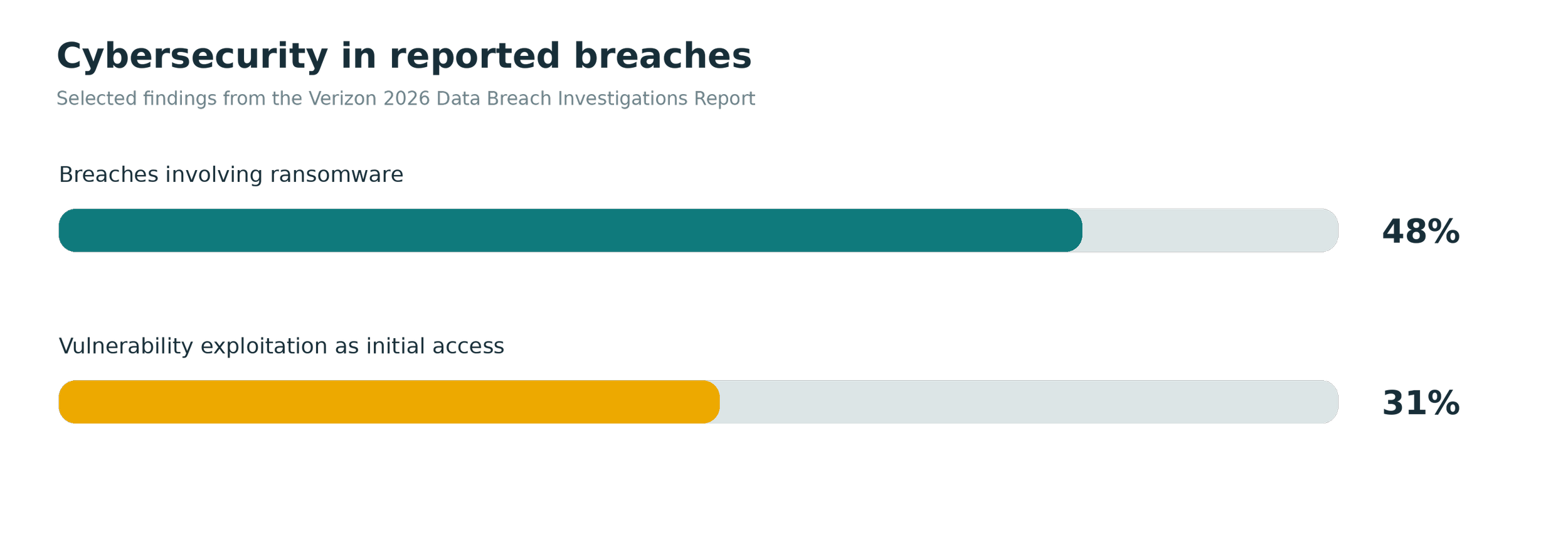
According to Verizon's 2026 Data Breach Investigations Report, exploitation of software vulnerabilities accounted for 31% of initial breach access, while ransomware was involved in 48% of the breaches analyzed. These findings demonstrate how technical weaknesses and malicious software continue to affect organizations despite improvements in security technology.
At Ziman Agency, we believe cybersecurity should be part of ordinary business management rather than something companies consider only after an incident. Our perspective is also informed by practical cybersecurity research, including a regional network of more than 10 specialists based in Iraq and the Kurdistan Region, alongside documented work involving vulnerability discovery and responsible security reporting.
Understanding how cyberattacks affect businesses
Many people associate cyberattacks with complicated software or advanced technical activities, but security incidents can begin with something as ordinary as an employee opening an attachment, responding to a fraudulent payment request, or using an outdated application.
A company may receive a message that appears to come from a regular supplier asking for payment to a new bank account. The message might include legitimate invoice references, professional language, and familiar company information, but without proper verification, an employee could transfer money to someone impersonating the supplier.
Other security problems are less visible. A web application might allow someone to access another customer's information because permissions were not implemented correctly, or an application might contain a weakness that allows unauthorized interaction with its database.
These examples demonstrate why businesses need to consider both technical protection and everyday working procedures. Employees must understand how to handle unexpected requests, while technical teams need to examine the systems that store and process important information.
What historical incidents have taught us
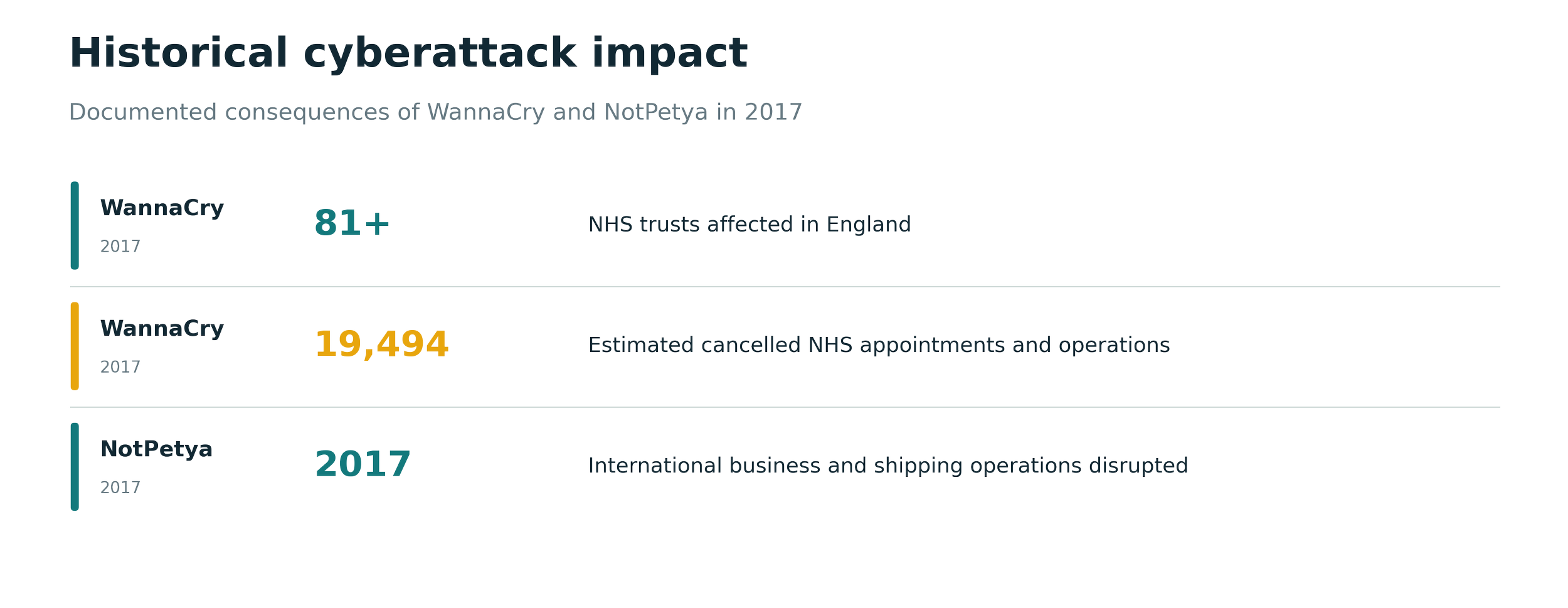
In May 2017, the WannaCry ransomware attack disrupted organizations in multiple countries, including healthcare services in England. According to the United Kingdom's National Audit Office, at least 81 of 236 NHS trusts were affected, and the estimated number of cancelled appointments and operations reached 19,494.
The consequences were not limited to computers or IT departments, because patients experienced cancelled appointments and healthcare organizations had difficulty maintaining normal services.
Later that year, the NotPetya cyberattack disrupted international businesses, including shipping company Maersk, demonstrating how problems involving digital infrastructure can interfere with logistics and commercial operations across multiple countries.
These incidents show that cybersecurity problems can affect people and businesses far beyond the organization where the incident first occurs. A weakness in one system may interrupt services, create financial losses, or affect other organizations that depend on it.
The lessons remain relevant today because companies continue to depend on connected technology, external providers, and digital information.
Cybersecurity in the Middle East
Across the Middle East, businesses are expanding their use of electronic payments, online services, cloud platforms, connected applications, and digital communication. These developments support business growth and improve access to services, but they also make security management an increasingly important part of operating an organization.
In Iraq and the Kurdistan Region, businesses are becoming more dependent on digital platforms for communication, financial transactions, and customer management. Similar developments are taking place across Saudi Arabia, the United Arab Emirates, Qatar, Türkiye, and other regional markets.
A small medical clinic may maintain patient records electronically, while a trading company may rely on online payments and supplier communication. If these systems become unavailable or are accessed without authorization, the consequences can affect business operations and confidential information.
Cybersecurity should therefore not be considered an issue that concerns only large banks, government institutions, or international technology companies. Smaller businesses also hold information that requires protection, and their ability to recover from a serious incident may be limited by available resources.
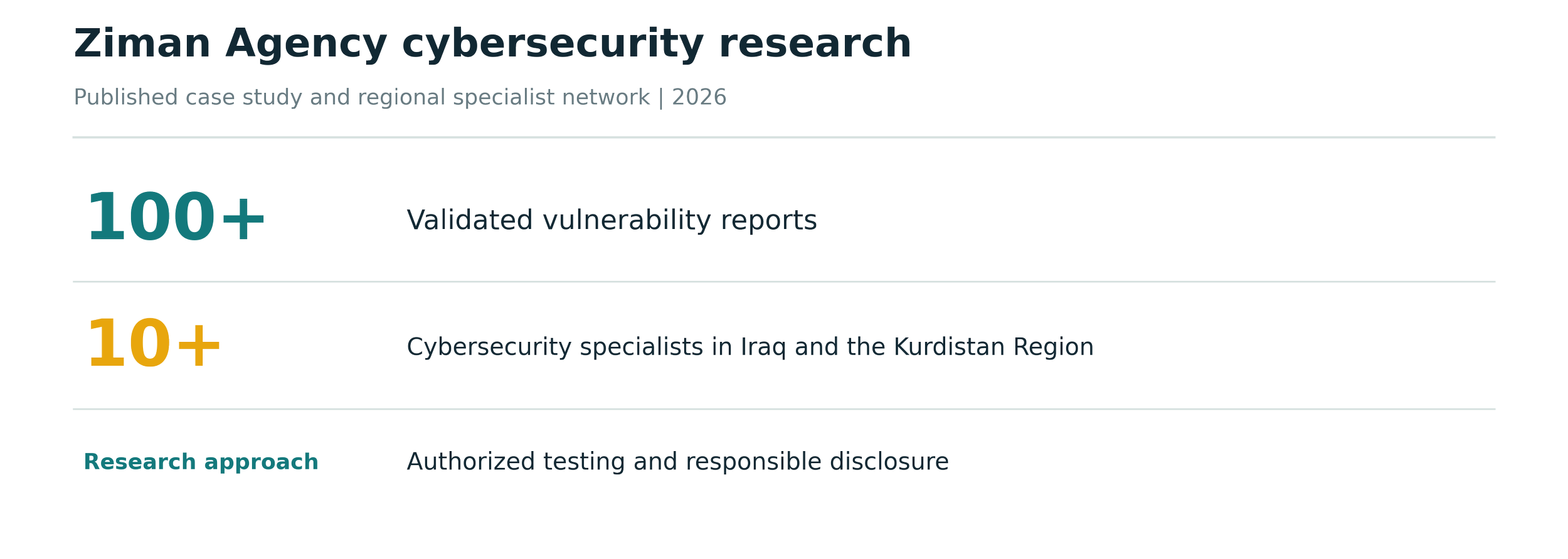
The region also has technical professionals capable of supporting security research, software testing, and vulnerability discovery. At Ziman Agency, our cybersecurity specialist network includes more than 10 professionals based in Iraq and the Kurdistan Region, providing access to regional expertise for suitable authorized technical engagements.
What our cybersecurity research shows
Ziman Agency's published case study, Bug Bounty & Cybersecurity Vulnerability Discovery, documents security research carried out through authorized public and private vulnerability disclosure programs during 2026.
Across these activities, our case study reports more than 100 validated vulnerability findings involving web applications, application programming interfaces, authentication systems, and other digital components.
The research included weaknesses related to access control, SQL injection, sensitive information exposure, and business logic, with technical findings documented and reported through responsible disclosure processes.
These technical terms may be unfamiliar to ordinary business owners, but the consequences can be understood through practical examples.
An access control weakness may allow someone to view information belonging to another user, while an SQL injection vulnerability can allow improperly handled input to interfere with database operations. Business logic weaknesses may arise when an application does not properly enforce the rules associated with activities such as account permissions, transactions, or other important functions.
A website or application can appear to work normally while containing weaknesses that its users and administrators have not noticed. This is one reason security testing is different from ordinary functional testing.
Our cybersecurity research involved manual investigation alongside established technical tools, with findings documented so that the responsible security teams could review and investigate the reported issues.
An important part of this work is maintaining proper authorization and respecting the scope of each program. Security research must be carried out under appropriate permissions, and confidential information should be handled responsibly.
These findings provide a practical example of why companies should consider security assessment as part of the development and maintenance of digital services.
The full case study is available on the Ziman Agency website:
Bug Bounty Cybersecurity Vulnerability Discovery
Why identifying vulnerabilities is only part of the process
Finding a security weakness is important, but organizations must also determine how serious it is, what information or systems could be affected, and which corrective measures should be prioritized.
Verizon's 2026 research found that the median time to fully remediate tracked critical vulnerabilities was 43 days in its reporting dataset. It also reported that only 26% of tracked critical vulnerabilities were fully remediated.
These findings highlight the difference between knowing that a problem exists and completing the work necessary to address it.
A company may receive a technical report identifying a vulnerability, but corrective action can require software changes, additional testing, coordination with external providers, or changes to access permissions.
Some weaknesses may require immediate attention because they are actively being exploited, while others may need to be prioritized according to the possible impact and the systems involved.
Businesses should therefore establish procedures for reviewing security findings, assigning responsibility, and verifying that corrective actions have been completed.
Security testing is most useful when the findings are connected to a practical process for reducing risk.
The importance of communication and localization
Cybersecurity also depends on how well information is communicated to employees and customers.
An international company may employ people who speak Kurdish, Arabic, Turkish, English, German, or several other languages, while its internal security policies and technical instructions are available only in English.
When employees do not fully understand these instructions, important procedures may be misunderstood or overlooked.
For example, a company may explain how to report compromised accounts, identify fraudulent messages, or protect confidential information, but some employees may not understand the terminology used or the actions required.
Localization can help organizations communicate these instructions accurately and naturally across different languages, particularly when preparing employee training, software warnings, privacy notices, incident reporting procedures, and customer communications.
At Ziman Agency, our work in language and localization services gives us a practical understanding of how terminology and communication affect the way information is received.
Technical controls remain necessary, but employees also need instructions that they understand and can follow consistently.
Protecting Client Data in Localization and AI Projects
Data protection is also an important consideration in language services, localization, and artificial intelligence projects because these activities can involve information belonging to clients, employees, customers, and other individuals. Translation assignments may include contracts, financial records, medical documents, or internal business communications, while AI data projects may involve text, audio recordings, images, and other information collected for training, evaluation, or technical development.
Organizations providing these services need to understand how client information is received, accessed, processed, stored, and shared. Depending on the project, this may require confidentiality agreements, restricted access, secure file transfer, appropriate data retention procedures, and compliance with applicable privacy requirements.
Working with remote specialists and international teams introduces additional considerations, particularly when project materials are accessed from different locations or processed through external platforms. Companies should establish clear responsibilities for handling client information and ensure that personnel understand the confidentiality and security requirements associated with their work.
For Ziman Agency, this relationship between cybersecurity, localization, and AI data services is particularly relevant because our activities involve coordinating linguistic and technical expertise across regional and international markets. We believe protecting client information should be considered throughout the project workflow, from receiving the initial materials to completing the assignment and handling any remaining data according to agreed requirements.
What business owners should consider
Businesses do not need to begin with complicated security programs, but they should understand which information and systems are important to their operations and establish reasonable procedures for protecting them.
The NIST Cybersecurity Framework 2.0 provides a structure based on six functions: Govern, Identify, Protect, Detect, Respond, and Recover.
In practical terms, organizations should understand who has access to important information, how accounts are protected, whether software receives appropriate updates, and how essential files can be restored if a problem occurs.
They should also establish procedures for verifying financial requests, managing external contractor access, reporting suspicious activity, and responding to incidents.
Regular security testing can help organizations identify weaknesses that may not be visible during ordinary use, while employee awareness and clear management responsibilities can reduce risks associated with everyday business activities.
These measures cannot eliminate every possible security incident, but they provide a reasonable foundation for managing common risks.
Looking ahead
Businesses will continue adopting connected applications, automated processes, cloud services, and artificial intelligence tools, creating further opportunities to improve their operations.
However, these developments will also introduce additional responsibilities relating to information security, system access, and external service providers.
Organizations should not assume that a successful security assessment means their systems will remain secure permanently. Applications change, new features are introduced, and previously unknown vulnerabilities may be discovered.
This makes cybersecurity an ongoing responsibility that requires regular review, appropriate technical expertise, and communication between business management and the people responsible for maintaining digital systems.
For companies operating internationally, clear information sharing and suitable security procedures will remain important as collaboration across markets continues to expand.
Our perspective at Ziman Agency
Ziman Agency works across language services, localization, AI data, and technology talent support, including access to cybersecurity specialists based in Iraq and the Kurdistan Region.
Our regional network of more than 10 cybersecurity professionals and our published research involving more than 100 validated vulnerability reports provide a practical foundation for understanding the security challenges associated with web applications and digital services.
We recognize that cybersecurity involves different areas of expertise, including vulnerability research, security assessment, application development, incident response, and employee awareness. Each area requires suitable technical knowledge and clearly defined responsibilities.
Our role in technology engagements is to understand project requirements and coordinate appropriate specialist support within the agreed scope of work, while recognizing the importance of responsible information handling and professional communication.
We also believe businesses should have access to understandable cybersecurity information, particularly in markets where digital adoption is expanding and not every organization has a dedicated internal security department.
Conclusion
Cybersecurity has become part of everyday business responsibility because organizations increasingly depend on digital systems for communication, payments, information management, and service delivery.
Research from 2026 shows that software vulnerabilities and ransomware remain important concerns, while historical incidents demonstrate how security problems can affect healthcare, international commerce, and ordinary business activities.
Our experience at Ziman Agency, including authorized vulnerability research and the work of our regional cybersecurity specialist network, reinforces the importance of identifying weaknesses, documenting findings responsibly, and understanding the risks associated with connected technology.
For businesses in Iraq, the Kurdistan Region, the wider Middle East, and international markets, cybersecurity should be considered alongside other operational responsibilities rather than treated as a separate technical issue.
Protecting information and maintaining reliable services require continuous attention, appropriate technical support, clear communication, and practical decisions that reflect the needs of each organization.
References
Ziman Agency. Bug Bounty & Cybersecurity Vulnerability Discovery. 2026.
Verizon. 2026 Data Breach Investigations Report.
UK National Audit Office. Investigation: WannaCry Cyber Attack and the NHS. 2017.
National Institute of Standards and Technology. Cybersecurity Framework 2.0. 2024.
Clifford Stoll. The Cuckoo's Egg. 1989.
Kevin D. Mitnick and William L. Simon. The Art of Deception. 2002.
Ross Anderson. Security Engineering. Third Edition. 2020.
About Ziman Agency
Ziman Agency provides language and localization, AI data and multimedia, and technology talent support through both in-house and remote specialists across the Middle East and worldwide, including coordination of cybersecurity professionals for authorized technical engagements.
Website: www.ziman.agency
Email: info@ziman.agency
© 2026 Ziman Agency. All rights reserved.